How to Use Interlinear – In Our Day
This guide shows, step by step, how to open the Hebrew and Greek Scriptures for yourself and see what the writers actually wrote.
⚠ Optional links: a caution
Every effort has been made to keep this site faithful to the oldest and most reliable manuscripts of the Scriptures, in agreement with the New World Translation, and free of misleading ideas and advertising. A few links lead to other sites for those who want them. Each is marked ⚠ Optional, because those sites may show unwanted ads or ideas. Links to jw.org are not marked; they are the site's own teaching source. ✓ Why you can trust this site ›
Built on the oldest, most reliable manuscripts
- Hebrew Scriptures: the Masoretic Text, the Hebrew text carefully preserved by the Masoretes, whose oldest complete copy is the Leningrad Codex of 1008 C.E. The Dead Sea Scrolls, a thousand years older, show how faithfully it was copied.
- Greek Scriptures: the SBL Greek New Testament (2010), a critical text built from the earliest surviving manuscripts — papyri from about 200 C.E. and the great 4th-century codices Sinaiticus and Vaticanus — not from the late medieval copies behind the King James Version.
On a mobile device (Android or Apple phone or tablet)
- Tap any word. Its details slide up from the bottom of the screen.
- Scroll inside that panel to see the meaning, the study note and the word count.
- Tap Full screen for more room, and Small screen to go back.
- Tap ✕ at the top of the panel to close it and go back to the verses.
Search for a word
Type a word in the Search box at the top and tap Search. Each site searches its own part of the Bible: the Hebrew site searches Genesis to Malachi, the Greek site Matthew to Revelation.
- Search in English: soul, spirit, worship, God.
- Search by Strong's number: H5315 or G5590.
- Search by the original word: nephesh, ruach, sheol, psyche, pneuma, gehenna, latreuo.
The results list the Hebrew or Greek words that match, with their meanings and how many times each occurs. Tap a word to list every verse that uses it, book by book, then tap a verse to open it, highlighted. Tap ✕ to close the results.
Getting around
The interlinear is two sites: the Hebrew Scriptures (Genesis to Malachi) and the Greek Scriptures (Matthew to Revelation). A button at the top of each takes you to the other.
- Pick a book and a chapter from the two boxes at the top.
- Use ‹ and › to step to the previous or next chapter. The next chapter is already loaded, so it opens at once.
- Every chapter has its own address. Add
#book-chapterto the end of the link to open it directly, for example#exodus-5,#1-samuel-17or#john-1. Add a verse to go straight to it:#deuteronomy-6:13. Copy these links into your notes or messages. - Four tick-boxes under the header switch lines on and off. American Standard - ASV and Strong's numbers are ticked when you arrive:
- American Standard - ASV (on) — the whole verse in English, at the top of each verse box, from the American Standard Version of 1901. It uses "Jehovah" in the Hebrew Scriptures. The green NWT › button beside it opens the same verse in the New World Translation on jw.org. The ASV is used until permission is received from jw.org to show the New World Translation wording here.
- Transliteration (off) — the word in English letters; tick it to sound the words out.
- Strong's numbers (on) — the reference number for each word.
- Grammar codes (off) — tick it to see the codes under each word.
The Introduction, sources and biographies button explains where every word comes from.
Reading a word
At the top of each verse box is the ASV line: the whole verse in English, with a green NWT › button that opens it in the New World Translation on jw.org.
Under it, every word stands in a small card, in the order the writer wrote it. Hebrew reads right to left, Greek left to right.
| Line | What it shows | Example (Exodus 5:2) |
|---|---|---|
| 1 | The original word | יְהוָה |
| 2 | How it sounds, in English letters (when ticked) | yĕhwāh |
| 3 | Its meaning in this verse | [is] Jehovah |
| 4 | Strong's number (H = Hebrew, G = Greek) | H3068 |
| 5 | Grammar code (when ticked) | HNpt |
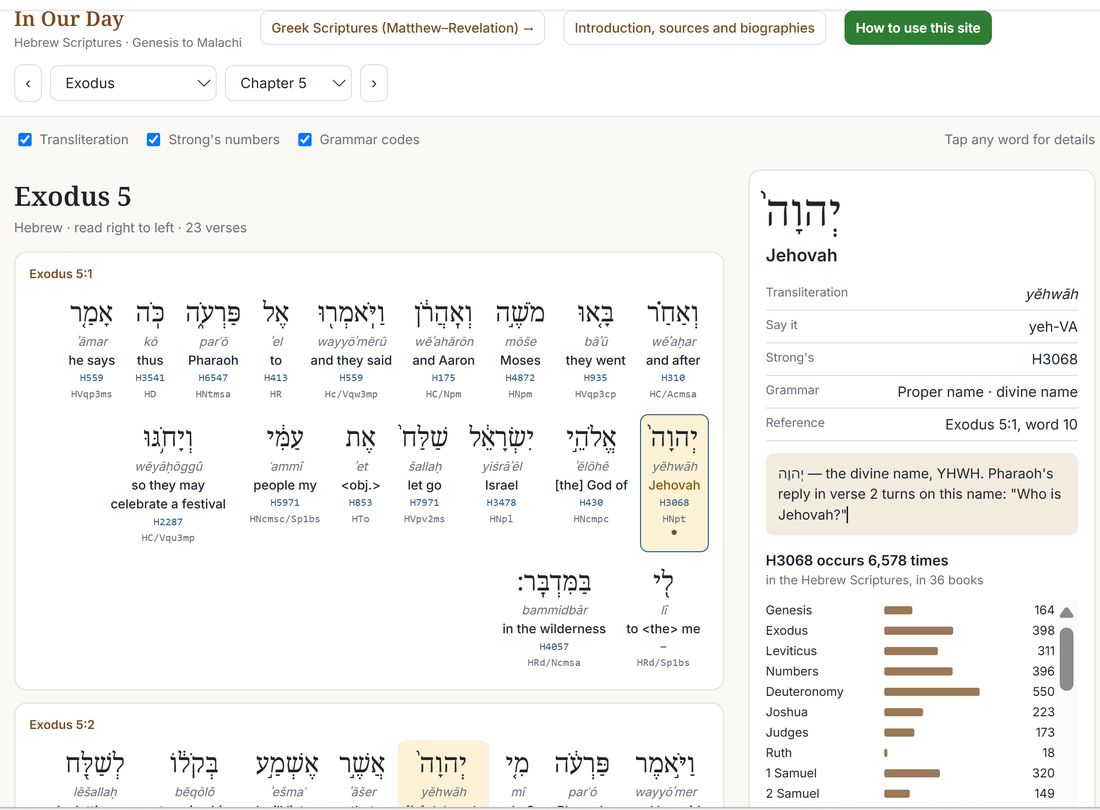
Tap any word and the panel on the right opens it up. On a phone the panel slides up from the bottom of the screen; tap ✕ to close it:
- the word large, with its meaning;
- how to say it, as in "yeh-VA";
- its grammar in plain English, such as "Proper name · divine name";
- a study note, if there is one;
- how many times the word occurs, with a bar for every book that uses it. Tap a book in that list to open it.
See it on screen: Exodus 5
Select your Bible book and chapter. Choose the book from the first box and the chapter from the second. The chapter opens almost instantly, and ‹ and › step back or forward a chapter just as fast.
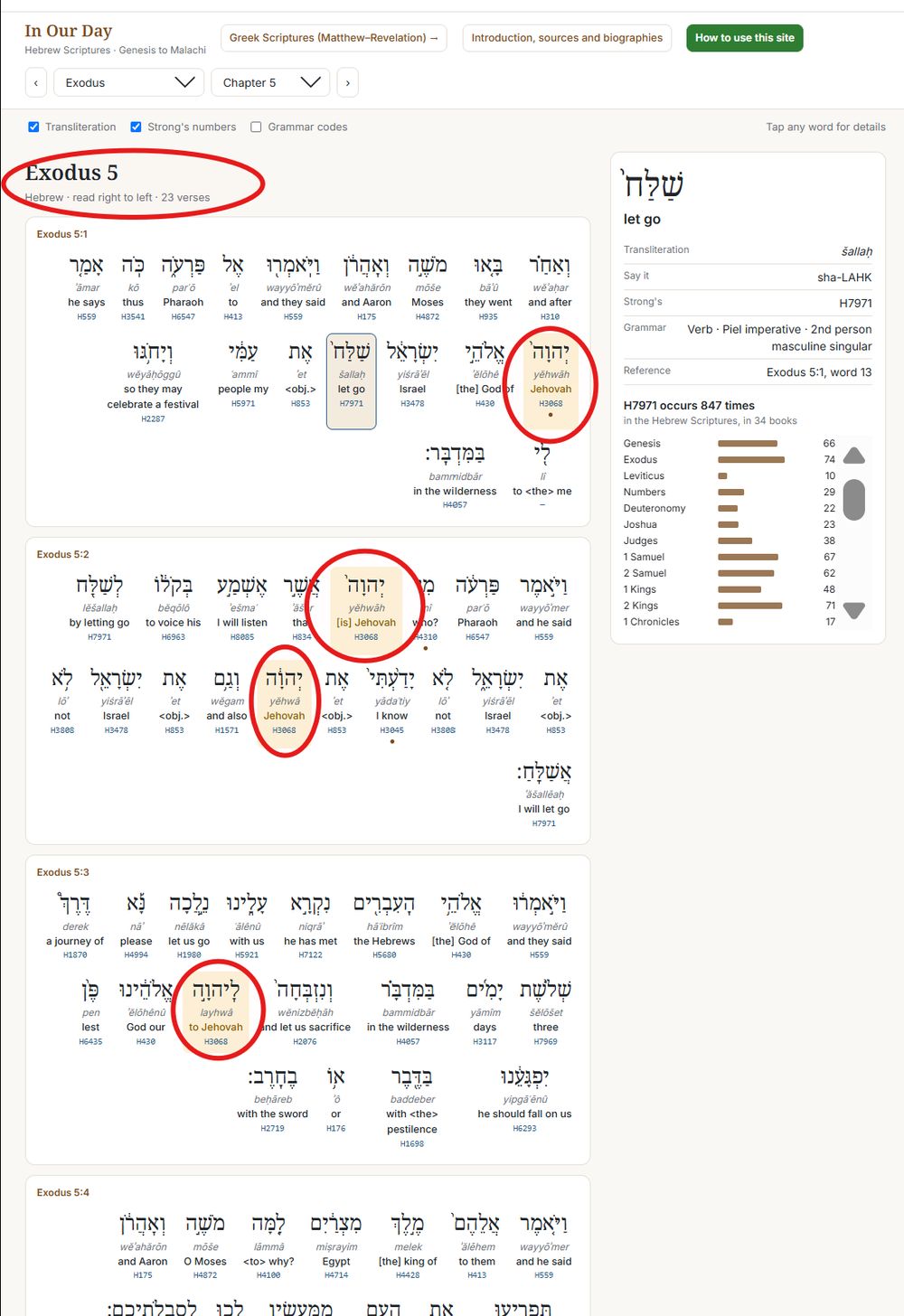
The chapter heading. Under the chapter name is a line telling you the language, which way to read it, and how many verses the chapter has: Hebrew · read right to left · 23 verses.
Why some words are gold. Every gold-shaded card is God's personal name, יהוה (YHWH), rendered Jehovah. In Exodus 5 the name appears seven times, four of them in the first three verses: Moses and Aaron speak in Jehovah's name (verse 1), Pharaoh asks "Who is Jehovah?" and says "I do not know Jehovah" (verse 2), and the Hebrews ask to sacrifice "to Jehovah" (verse 3). The gold lets you see at a glance how often the name stands in the text, which many Bibles hide behind "the LORD". The name sometimes carries a small Hebrew prefix, as in לַיהוָה, "to Jehovah", but the card is still gold.
The card with a dark outline is simply the word you last tapped; its details are in the panel.
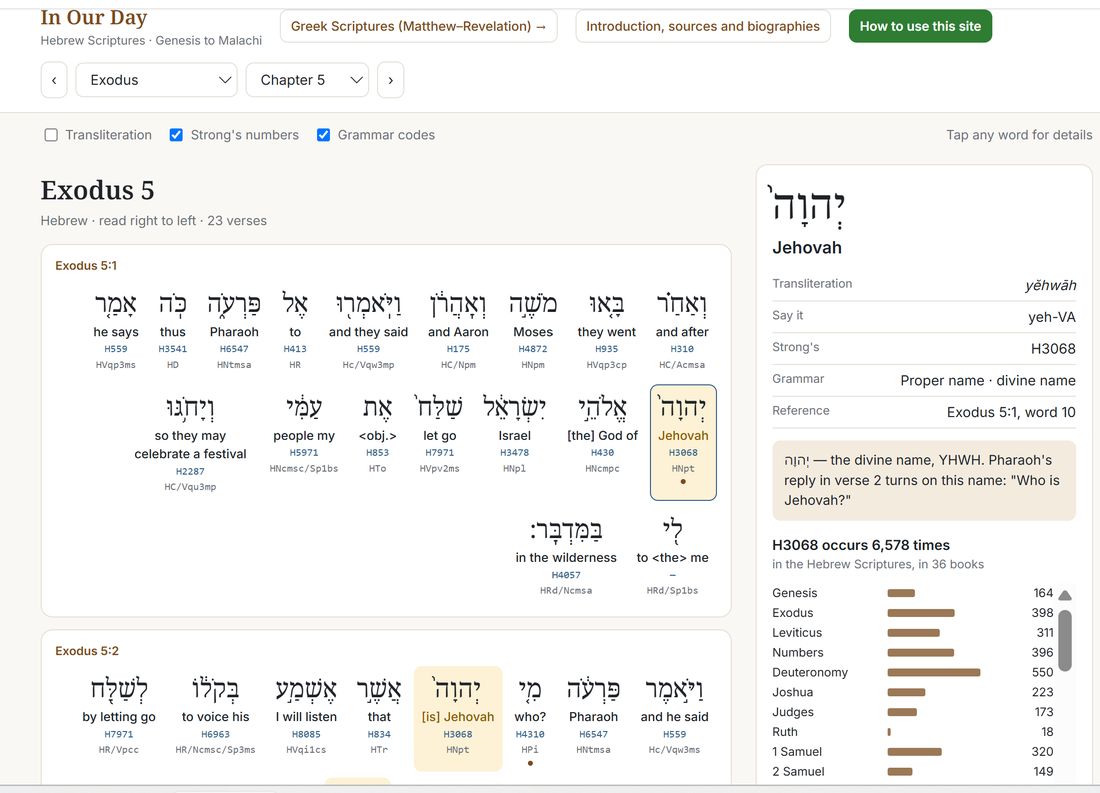
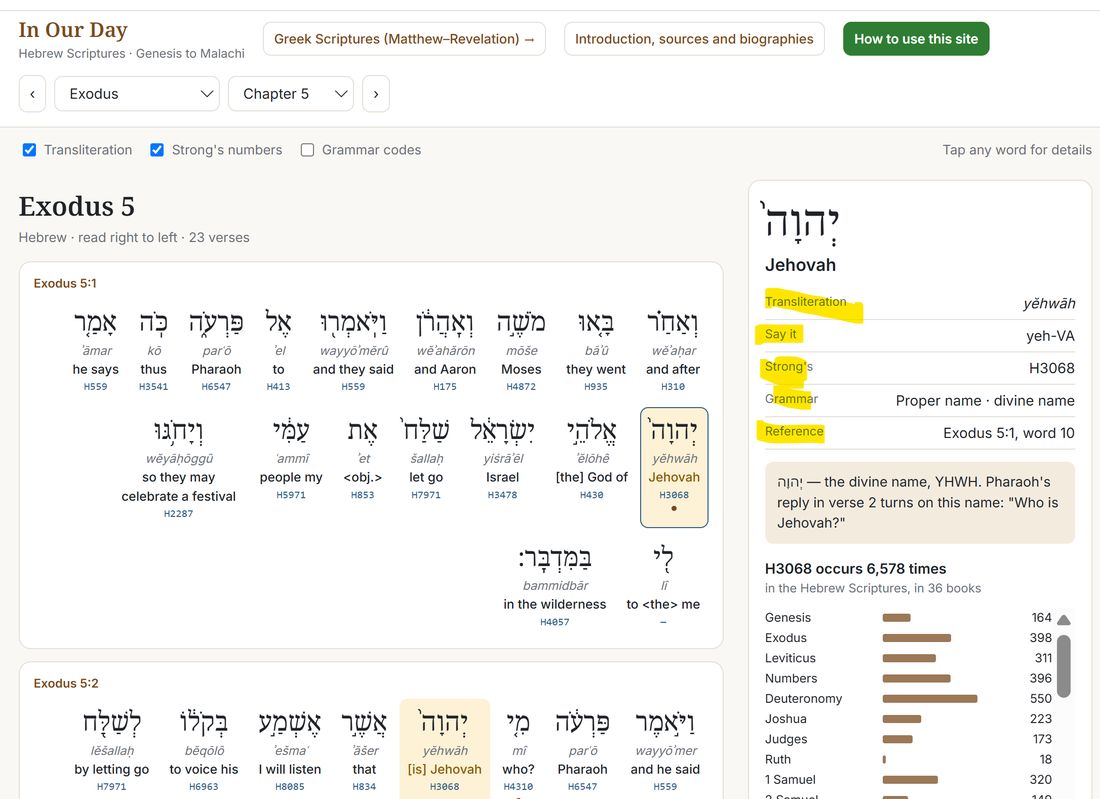
Here is how the screen looks with the tick-boxes on and off. Each picture shows Exodus 5, with Jehovah (יְהוָה) tapped in verse 1.
1. All three lines on. Transliteration, Strong's numbers and Grammar codes are all ticked. Under each Hebrew word you see how it sounds, its meaning, its Strong's number and its grammar code.
2. Two lines on. Transliteration is off. You see the meaning, the Strong's number and the grammar code.
3. One line on. Only Grammar codes is ticked. You see the meaning and the grammar code.
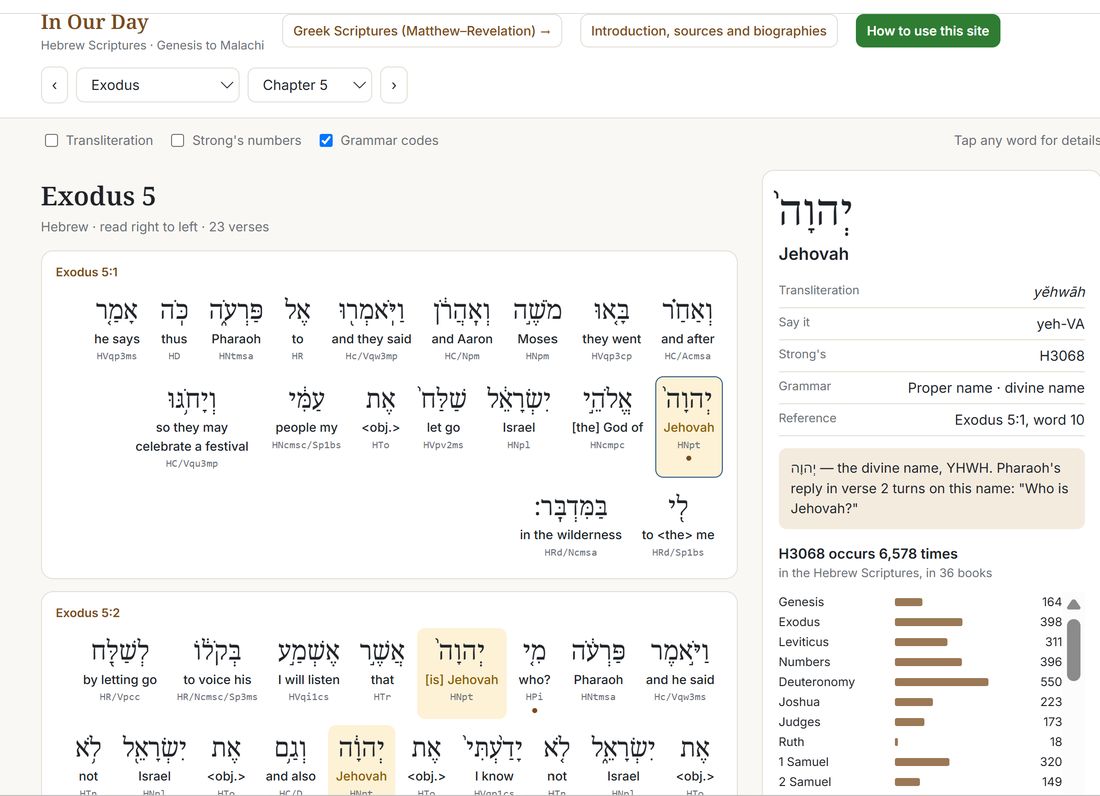
4. All lines off. Just the Hebrew and its meaning: the cleanest way to read a verse.
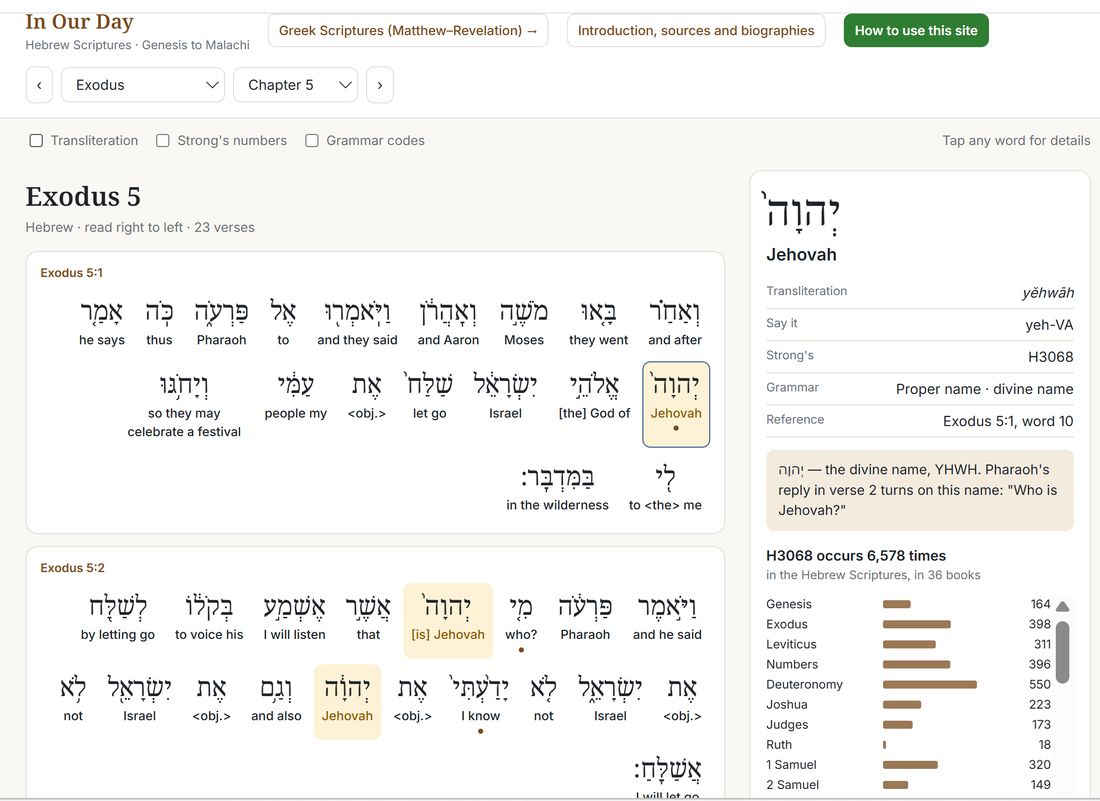
5. What each line in the panel means. Tap any word and the panel shows:
| Line | What it tells you |
|---|---|
| Transliteration | The word written in English letters, as scholars spell it: yĕhwāh. |
| Say it | A simple guide to pronouncing it; the capital letters are the stressed part: yeh-VA. |
| Strong's | The blue Strong's Lookup box shows James Strong's own definition and how the King James Version renders it. Below it is the word's Strong's number (H for Hebrew, G for Greek); tap it to open the full Strong's Detail page: the word's origin, definition, KJV renderings, its count in every book and every verse that uses it. |
| Grammar | What kind of word it is, in plain English: here, "Proper name · divine name". |
| Reference | Where you are: book, chapter, verse, and the word's place in the verse (Exodus 5:1, word 10). |
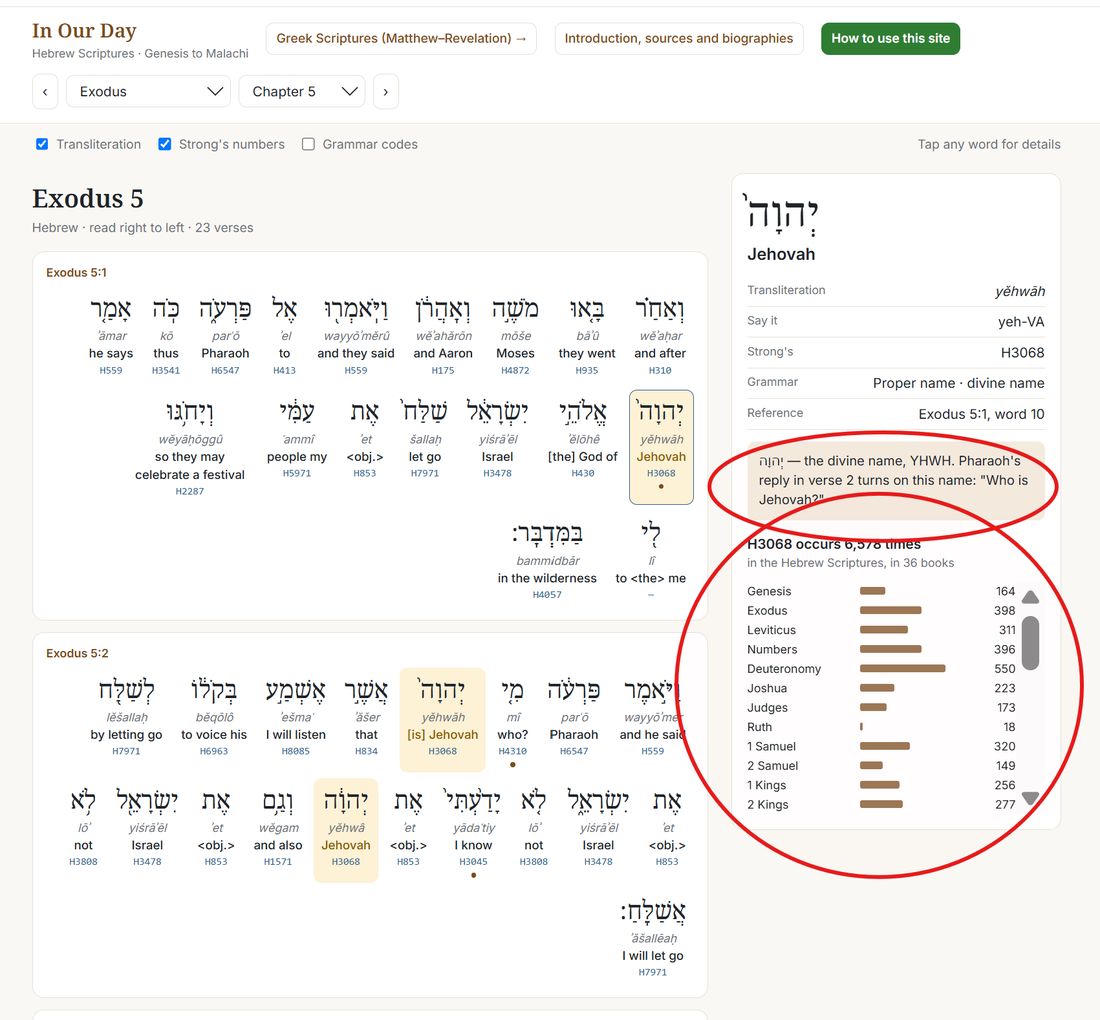
6. The study note and the word count. Below those lines:
- The study note (the shaded box) explains why this word matters here. Look for the small dot under a word: it means a note is waiting.
- The word count shows how many times the word occurs in the whole Bible, and in how many books: H3068 occurs 6,522 times, in 36 books. (The picture below shows 6,578, the count before November 2026; see why.)
- The bar for each book shows how often that book uses the word. Scroll the list to see every book, and tap a book's name to open it.
Marks to look for
- A gold card is the name Jehovah.
- A small dot under a card means a study note is waiting — tap it.
- [ ] marks English words added for sense; small grey words in brackets, like (the) or (object marker), mark a Hebrew or Greek word with no English equivalent.
- Under a Hebrew verse number, a gold quoted at … link means the Greek Scriptures quote that verse. Tap it to see where.
Have you ever wondered why Pharaoh said he did not know God? (Exodus 5)
Most Bibles have Pharaoh say, "Who is the LORD? … I do not know the LORD." That makes a man who worshipped dozens of gods — and was himself worshipped as one — sound as if he did not believe in God. The Hebrew shows what he really said.
- Open Exodus 5 on the Hebrew site.
- In verse 1, find the gold card יְהוָה — Moses and Aaron say, "Thus says Jehovah, the God of Israel: Send away my people." Tap it and read the note.
- In verse 2, read Pharaoh's reply word by word, right to left: who? … [is] Jehovah … not … I know … Jehovah. The name is there twice.
- Tap מִי ("who?") and יָדַעְתִּי ("I know") — the dotted cards — for their notes.
What you see. Pharaoh did not deny that God exists. He refused to recognise one God by name: Jehovah, the God of a slave people. The rest of Exodus answers his question — "the Egyptians will know that I am Jehovah" (Exodus 7:5). Replacing the name with a title hides the whole contest.
Go further. Tap the name and look at the count: H3068 occurs 6,522 times in the Hebrew Scriptures. Scroll its book list — Jeremiah and Psalms use it most.
Have you ever wondered whether Jesus used God's name? (Matthew 4)
When the Devil tempted Jesus, Jesus answered three times with "It is written", each time quoting Deuteronomy. Every one of those verses has the name Jehovah in the Hebrew.
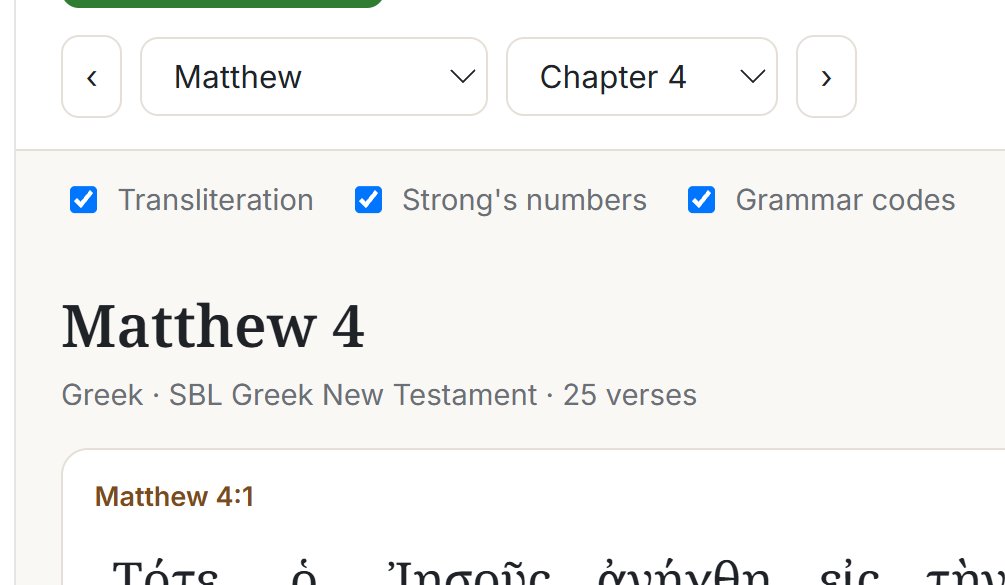
- Open Matthew 4 on the Greek site.
- Find the three gold words, in verses 4, 7 and 10. The Greek reads theou (God) or kyrion (Lord); the English line reads Jehovah.
- Tap each one. The panel shows:
- what the Greek word itself says ("Restored — the Greek reads …");
- which Hebrew verse Jesus is quoting — tap that reference to jump straight to the Hebrew verse;
- how many other Bible translations also use the name there.
- Tap List the translations to see each one by name, number, translator and year.
- On the Hebrew verse, the name stands in gold in the very words Jesus quoted. The quoted at link under the verse number brings you back.
| Matthew | Jesus quotes | Other translations using the name |
|---|---|---|
| 4:4 | Deuteronomy 8:3 | 60 |
| 4:7 | Deuteronomy 6:16 | 168 |
| 4:10 | Deuteronomy 6:13 | 173 |
Go further. Open Luke 4. In verse 18, Jesus reads Isaiah 61:1 in the synagogue: "Jehovah's spirit is upon me." The same pattern runs through the Greek Scriptures — 202 places are marked so far.
Have you ever wondered what John 1:1 really says? (John 1)
John 1:1 uses the Greek word for God twice, and writes it differently each time. An interlinear lets you see the difference for yourself.
- Open John 1 on the Greek site.
- Tick Grammar codes at the top.
- Look at the middle of verse 1: πρὸς τὸν θεόν — "with the God". The word τὸν (code T-ASM) is the article, "the".
- Now the last clause: θεὸς ἦν ὁ λόγος. Here θεὸς has no article before it, and it stands before the verb.
- Tap both dotted words for their notes.
What you see. The Word was with "the God" — and then is described with θεὸς without the article. Translations render that last clause "God" (most), "a god" (New World Translation) or "divine" (Moffatt, Goodspeed). This interlinear's English line is in agreement with the New World Translation: "[a] god". The brackets show the "a" is supplied in English, as it is at Acts 28:6, where most Bibles write "a god" for the same Greek word. Tap the word and the note gives the plain gloss "God" as well. Scholars still debate how far the grammar alone decides it. What no one disputes is that the two words are written differently, and now you can see it.
Have you ever wondered whether every verse in your Bible was in the original? (1 John 5)
The Greek here is the SBL Greek New Testament, built from the earliest manuscripts. Words that copyists added centuries later are simply absent — and that is worth seeing.
- Open 1 John 5 and read verses 7 and 8. Verse 7 says only, "For there are three that testify."
- Compare a King James Bible. Its verse 7 adds "in heaven, the Father, the Word, and the Holy Ghost: and these three are one." Those words are in no early Greek manuscript; they entered the Greek text only in the late Middle Ages.
- Open Acts 8 and look for verse 37 — it goes straight from 36 to 38.
- Open Mark 16. Verses 9–20 are kept but marked ⟦ ⟧, because the oldest manuscripts end at verse 8.
What you see. An interlinear is only as good as its Greek text. This one does not carry the late additions that older interlinears print.
Have you ever wondered how often God's name is really in the Bible? (Psalm 83)
Many Bibles print the name only a handful of times, if at all — the King James Version shows it in four verses. The Hebrew text tells a different story, and the word counts let you trace any word through the whole Bible.
- Open Psalm 83 and go to verse 18: and they may know that you, your name [is] Jehovah, you alone, the Most High over all the earth.
- Tap Jehovah. The panel says H3068 occurs 6,522 times, and lists every book it appears in.
- Tap Jeremiah in that list. The site opens Jeremiah 1, where the name appears in the opening verses.
- Try the same with any word. Tap name in the same verse to trace שֵׁם (H8034) through the Scriptures.
On the Greek site the counts work the same way. Tap θεός (God, G2316) in John 1:1 — it occurs 1,307 times across all 27 books.
Have you ever wondered where the nations came from? (Genesis 10)
Genesis 10 names 70 descendants of Noah's three sons, and says that from them "the nations spread out in the earth after the Flood" (Genesis 10:32). It was written about 3,500 years ago, and many of its names are still on the map.
- Open Genesis 10 on the Hebrew site.
- In verse 6, tap מִצְרַיִם (Mizraim, H4714). It occurs 676 times; tap Exodus in its list and the same word reads "Egypt". Arabs still call Egypt Misr. Read more on jw.org: Mizraim · Egypt, Egyptian.
- In verses 2 and 4, tap יָוָן (Javan, H3120), forefather of the Ionians, the early Greeks. Assyrian inscriptions name them from the 8th century B.C.E. Read more: Javan · Greece, Greeks.
- In verse 15, tap צִידֹן (Sidon, H6721), Canaan's firstborn. The city named after him still stands in Lebanon, now called Saida. Read more: Sidon.
- In verse 21, tap עֵבֶר (Eber, H5677), the ancestor of Abraham, from whose name "Hebrew" evidently comes. Read more: Eber · Hebrew.
What you see. The interlinear shows each name as it was first written in Hebrew. Tap any name and its count list follows it through the rest of the Scriptures, where a man's name becomes a people and a land.
Go further. The map Origin of Nations on jw.org places all 70 descendants of Noah, and the article Nations explains how they spread.
Quick reference
| You want to | Do this |
|---|---|
| Open a chapter | Choose the book and chapter at the top, or add #book-chapter to the link |
| Go to the next chapter | Tap › (or Next chapter at the bottom) |
| Read the verse in English | The ASV line at the top of each verse |
| Read it in the New World Translation | Tap the green NWT › button beside the ASV line |
| See what a word means | Tap it |
| Find the study notes | Look for the small dot under a word |
| See where God's name is | Look for the gold words |
| Check a restored name | Tap the gold word: the Greek, the Hebrew verse quoted, the supporting translations |
| Jump to the Hebrew verse quoted | Tap the reference in the note |
| See where a Hebrew verse is quoted | Tap quoted at … under the verse number |
| Trace a word through the Bible | Tap it, then tap a book in its count list |
| See the grammar | Tick Grammar codes; tap a word for plain English |
| Switch Hebrew ↔ Greek | The button at the top of each site |
| Learn where it all comes from | Introduction, sources and biographies at the top |
Ready for more? Try the research projects on the Dig Deeper page.
Links to start with
- Exodus 5 — "Who is Jehovah?"
- Deuteronomy 6:13 — the verse Jesus quoted
- Psalm 83 — "your name is Jehovah"
- Genesis 10 — the nations, still on the map
- Matthew 4 — Jesus answers with God's name
- John 1 — two ways of writing "God"
- 1 John 5 — a verse that was added later
✓ Why you can trust this site
⚠ Caution
Links marked ⚠ Optional leave this site and may contain unwanted ads or ideas. jw.org links are not marked.
In Our Day is built to be educational, informative and FUN, but safe, keeping strictly to the "Truth" and "The Way".
Keeping to the truth
- Jehovah's name restored wherever the Hebrew has it, and in the Greek Scriptures where the New World Translation shows it belongs.
- Quotes linked both ways. When the Greek Scriptures quote the Hebrew, you can tap across and see God's name in the original.
- John 1:1 reads "[a] god", with a green "why" box, scriptures, and drop-downs that explain it.
- Gehenna is shown as "Gehenna", with a note that other translations render it "hell".
- Strong's definitions are labelled "Strong's 1890 wording, not In Our Day's".
- The oldest manuscripts: the Masoretic Text for the Hebrew, the SBL Greek text for the Greek.
Safe: no ads, no stray teaching
- No advertising and no sign-in, anywhere on the site.
- jw.org is the teaching source. Studies and projects point there for explanation.
- Every other outside link is marked ⚠ Optional, in red, because those sites may show unwanted ads or ideas.
- A red caution line sits at the bottom of every page.
Educational and informative
- Every verse in English from the American Standard Version of 1901, with a green NWT › button to read it in the New World Translation on jw.org.
- Tap any word to see its Hebrew, Aramaic or Greek details: meaning, how to say it, grammar in plain English, and a note.
- Strong's Lookup in the panel, and a full Strong's Detail page for every word.
- Same word elsewhere, with verse links, and count bars showing how often it occurs in each book.
- Search by English word, Hebrew or Greek word, or Strong's number.
- Step-by-step studies in How to use this site, and sources and biographies in the Introduction.
Fun
- Did You Know? facts, also scattered through the Introduction.
- Dig Deeper: 15 research projects, each with a workbook for your notes.
Easy to use
- The same menu bar on every page, fast book and chapter selection, and a word panel that slides up on phones.